
|
||||
Y2K Plus 10
It's amazing how fast time travels when we are busy. I cannot believe it has been 10 years since the Y2K craze. Can you remember the days when we all wondered if the world was going to end, or at least life as we knew it was going to stop? The worries were that all of the computers in the world would shut down when the date format would roll to '00. Businesses spent an unbelievable amount of money upgrading technology out of fear. We had little proof of what would happen on that fateful day. Our entire staff was on call, in the event there were problems we would be there to help. The night was pretty un-eventful. Not even one phone call. I think we all breathed a sigh of relief when the world kept turning. On a more serious note, I think it was amazing that companies invested money into new and updated technology simply on fear and speculation of what "could" happen. Those days are long gone and the big focus on technology is how can it pay for itself? What is the return on investment (ROI)? We have invested a significant amount of time and money educating ourselves on "best of breed" technologies that can pay for themselves in the first month of deployment. We understand that technology exists for one specific purpose, and that is to streamline processes. In that past, some of us have purchased technology only to find out that it did not produce the ROI that was expected. The reason for that may have been improper implementation, lack of training, or a combination of the two. With our new programs, we have addressed these concerns, as well as the other main risk, obsolescence. With our new programs, not only can we fix the price of technology, but we can fix the cost as well as minimize the obsolescence. All signs in the economy point to the fact that we will recover in 2010. Now may be the time to look inside your business and your processes and give one of our advisors a call. We can help you look deeper into your business and show you some ways that technology can help you achieve your business goals, increase your profits, increase customer satisfaction, while not only being free from cost, but increasing your bottom line from day 1. If you would like to see the new trends in technology, look no further than The Connect Group. 
Cloud ComputingIf you have been keeping your eyes on all the Buzz in the computer industry, you have probably heard the terms Cloud Computing or Software as a Service (SaaS). If you are confused about what this means, you are not alone. Basically what these two terms mean are outsourcing some or all of your computing to an outside source. Software as a Service is where a third party will host your software and maintain the subscriptions, updates, maintenance and help desk outside of your organization. A great example of this would be www.salesforce.com. Cloud computing really takes this to the next level. In addition to hosting the software outside, you are renting processor, RAM, and hardrive space outside of your organization. There are several advantages to these types of services:
Be careful, however, there are some inherent disadvantages to the technology as well. Some clients are nervous about losing control of their data, which is usually critical to the success of the business. Security can be a concern as well. Can we really trust someone else with our trade secrets? In addition, the inability for payments to ever end can be a concern for clients, especially those who typically pay cash for their systems. In short, you will need to determine if this type of technology makes sense for your business. I would recommend you interview your prospective vendors and discuss the previous points and see how they propose to relay your concerns. If you would like to investigate your options into this type of technology, please give one of our reps a call and we can help you determine if this technology makes financial sense for your organization. 
Hosted Voice SystemsHosted voice systems have been gaining steam in the last few years. Basically, hosted voice systems are built on the premise that it is more cost-effective for customers to leverage the phone system owned by the provider, rather than buying their own system and managing and maintaining it themselves Hosted voice systems can provide access to features that may not be accessible to smaller companies if they were on their own, like ACD, call reporting, or call recording. With the hosted systems, the premise is that we use the internet, or a private network to connect the remote phones to the main system located at the service provider's location. The service provider keeps the system's software up to date, does all programming changes and troubleshoots any problems, all for a fixed monthly price. Some also include the other charges like dial tone and long distance. In some instances, hosted systems work very well, but as with anything, there are some disadvantages as well: Bringing your voice calls over the internet can cause some issues. Since change is inevitable in technology, the rapid rate of upgrades can pose some risk as well. Lastly, is the company selling the hosted system focused on customer functionality? The Connect Group offers a range of options from buying your own system to 100% hosted and a couple in between. If you are thinking hosted may be an option for your business, please call, click or stop by and we can help. 
OutsourcingWhen I was growing up, my father was able to do just about anything from fix a car, fix the plumbing, build a garage, paint, roof, cook, or even plant a garden. Back in those days, I think this was pretty common for most people, but as we continue to make everything much more complex, that is becoming increasingly difficult. Technology seems to affect every part of life. Cars have certainly become more complex with "codes" to tell the mechanic what is wrong. Back in the day, our fathers knew what was wrong by the sound they heard. Building codes have increased making it more difficult to build your own garage, finish your basement, or even add on a deck. I think that business is following the same parameters. Each of us needs to understand what our core competency is. In that I mean, "What I am the best at", and then focus on that like a laser beam. If we focus the bulk of our time doing that, we will grow our companies faster than we ever could by trying to do everything. Outsourcing helps us do just that. We hire accountants, attorneys, engineers, and contractors. We hire them because they are experts in their fields and it is more cost effective to use an expert than to try and do those jobs ourselves. We, at Connect, offer a similar service for your technology. We are the experts in the technology field and we can help you grow your business faster by recommending the technologies that will help you increase your profitability and competitive advantage. We live and breathe this business, just like you do in yours. If you would like to see how Outsourcing your technology can help your business grow, call, click or stop by one of our offices today. 
Which Type of Conferencing would Benefit your Business?There are basically three types of conferencing: voice, video or web conferencing: Voice Conferencing, sometimes called a conference bridge is where we can connect multiple people together on the phone by having them dial into a number and then being placed into a conference. These can be very beneficial to hook in multiple people to talk about a problem that multiple people may have some input on. They are easy to set up, inexpensive and can be part of your phone system, or "pay as you use" services. Web conferencing is usually used in conjunction with a voice conference bridge. Web conferencing allows us to share our computer screen with other users. This can be used to present an idea to a customer, or used to show a remote employee how to work in a computer application. Some of the options of web conferencing include the ability to change control. Let's say I am presenting to a customer in California and I have the manufacturer participating and he is located in Denver. I can open the conference, share my desktop and then allow the manufacturer in Denver to take control of the presentation and actually control my computer from wherever he is located. All the while, the client in California is seeing what we are presenting. We can also integrate web cameras into the web conferencing, allowing the people we are collaborating with to see us as well as the content. Some newer versions are now allowing several web cameras to be displayed on the screen allowing all users with web cameras to see each other. Web conferencing can also be part of the phone system, or a monthly subscription service. This type of conferencing is a little more expensive, but still less than full blown video. Video conferencing is more of a room type environment where we have people gathered into a conference room and we can project images of other conference rooms on the screen allowing users to more closely collaborate without having to travel. Some video conferencing systems will integrate the ability to share computer desktops, paperwork, etc over the video conference as well. Video is the most expensive type of conferencing, but can ROI quickly when displacing travel. If you would like to see how conferencing can increase your bottom line, give one of our agents a call. Small Office Network Analysis
Have you noticed that IT systems seem to have become increasingly complex? In our experience, we have noticed that there is a communication gap between IT and ownership or management. We have developed a new program to help our clients deal with this. We have named the program SONA (Small Office Network Analysis). The SONA will be handled within one business day for networks of less than 20 workstations. We have a very defined process that allows us to accomplish three things in this condensed time frame: We understand and document your business goals. We then take some very important vital signs off of your current IT environment. We make prioritized recommendations of projects that will help get your Information Technology in line with your business goals. These prioritized projects can then be done on your time frame and budget, either by your current IT group or ourselves. The deliverables on this service are very comprehensive. We provide you a documented network diagram that details all of the devices on the network as well as a detailed inventory of the hardware on the network. We verify the security settings on your network, Windows patches and virus software. We also provide a complete list of all of the software loaded on all of the computers. We also verify the web presence of your company to ensure that your clients can get the information they need from your website. The feedback we have received from several clients on this process is that it really helps them get visibility into their systems and finally align their business goals with their Technology expenditures. If you would like to see how the SONA could help you get your business and Technology goals in perfect alignment, give one of our representatives a call. 
The Mobile DecadeAs we live in the "information age", we don't seem to notice how fast everything is moving until we take a look back at where we came from. If we look back 10 years, we can see that things really have moved very fast. The decade just passed, I would dub the decade of Mobility. In the past decade, consumers spent more on laptop computers than desktops for the first time in the history of computing. Consumers also spent more on mobile phones than on land lines. This was the decade where the microwave did not cook fast enough. Apple re-invented themselves by revolutionizing the music industry. In less than 10 years, the iPOD has become the standard for music, video and all things entertainment. TiVo has revolutionized the way we watch TV. We record all the programs we may want to watch, and then watch them at our leisure with no commercial interruptions. Cable and Satellite TV is moving in the same direction with providing on-demand access to television shows and movies. We can now watch them at our convenience and have the ability to pause, rewind, or fast forward. HDTV finally caught on in America. Today we are almost appalled if our favorite sport or television series is not broadcast in HD. The internet became a part of every-day life in America. Today we shop on-line, bank on-line, talk on-line. Our video games, televisions, iPOD's, and even alarm clocks are on the internet. We have constant access to information. In the world of photography, digital cameras have all but replaced the film type cameras. People print pictures at home, print them at a kiosk, or sometimes don't print them at all, they display them on a digital photo frame, or slide show on a computer or television. Mobile phones have also followed suit. Today we have Email, Navigation, Database Access all in our pocket. We can find the latest scores while on the go, get directions to a restaurant we have never been before, or check the price of that hot stock in our portfolio from wherever we are. And to think all this happened in 10 years. Just 10 short years ago we were all afraid the world was going to end because computers wouldn't know the difference between 1900 and 2000. I must say I am very excited to see what new technologies are yet to be developed in this decade and how they will just become normal. I am amazed at how things change, but in a short time almost become commonplace. 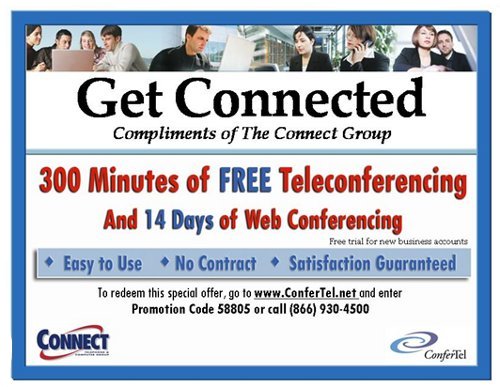
|
||||
|
You have received this email because you provided your email address to The Connect
Group, most likely in the course of a business activity.
If you do not want to receive any more mailings, unsubscribe.
|
||||
